Our overarching goal is to establish a sustainable and ethical model for elephant conservation in South Africa, providing a long-term solution for captive elephants. This goal includes granting them the freedom and dignity they deserve under the highest welfare standards and supporting their transition into thriving wild populations. To achieve this, we are committed to three key objectives: establishing an Elephant Rewilding Reserve, supporting the phased rewilding of captive elephants, and fostering community engagement and education.
The Elephant Rewilding Reserve will be managed as a protected ecological area, allowing wild zones to flourish undisturbed by human interference. This sanctuary will provide elephants with a safe and natural environment, contributing to a healthier ecosystem. Our approach includes acquiring suitable land and implementing established scientific protocols for identifying, reintegrating, and rewilding elephants. This careful process ensures that elephants can transition smoothly into natural habitats, promoting their well-being and ecological balance.
Community engagement and education are integral to our mission. We aim to involve local communities through interactive educational programs, fostering a deeper understanding of elephant biology, behaviour, and conservation. We promote inclusive conservation strategies to create a supportive environment for these efforts. Our vision is to create a space where science and conservation work together to heal and preserve wilderness and wildlife, setting a global example for ethical and effective wildlife management.
Establish an Elephant Rewilding Reserve in South Africa
The reserve will provide a secure environment for commercially exploited elephants to reintegrate fully into the wild and live out their remaining years wild and free.
Secure the Land for the Reserve
We aim to initially secure approximately 5,000 hectares of suitable elephant habitat with opportunities to expand into future wildlife corridors.
To ensure the reserve remains protected, we will obtain official conservation status by seeking its declaration as a Nature Reserve, with the Elephant Reintegration Trust as the management authority in perpetuity. The ownership model will ensure that the land is secured for the elephants without fear of future conflicting land use.
Properties with promising characteristics have been identified at the end of the Garden Route, known as the Sunshine Coast, in the Eastern Cape of South Africa. This area was once home to sizeable free-roaming elephant populations, which were made locally extinct through ivory hunting and land competition in the late 1800s and early 1900s. Elephants were returned to this region in the early 2000s through translocations from other reserves to support the establishment of fenced wildlife reserves. The region encompasses Albany Thicket Biome landscape, which consists of dense woodland and is renowned for its ability to support a high level of biodiversity (Hoare et al., 2006; Purdon et al., 2022).
We believe this area is an ideal elephant habitat because:
- It has abundant water availability due to various rivers and local weather patterns in this region of South Africa.
- Elephants within this landscape have been observed to exhibit low levels of stress-related behaviours, likely due to the thick vegetation that allows for expansive areas of refugia (observed; unpublished)
- Its subtropical thicket biome is rich in succulent vegetation adapted to handle animal grazing and high densities [Purdon et al., 2022].
- It has low human densities, thus reducing the risk of human-wildlife conflict.
The Proposed Land: Elephant Park Game Farm
A 5,573-hectare game farm with prime elephant habitat is currently available. The designated sections of land within Elephant Park in the Eastern Cape, with the Great Fish River forming the eastern boundary, fall under the jurisdiction of Ndlambe Municipality. This area has no existing land claims or foreseeable issues, particularly on the eastern side of the Great Fish River, making it less problematic. The park has the potential to expand northwestward, with the option to purchase the adjacent Sportsvale property for further development.
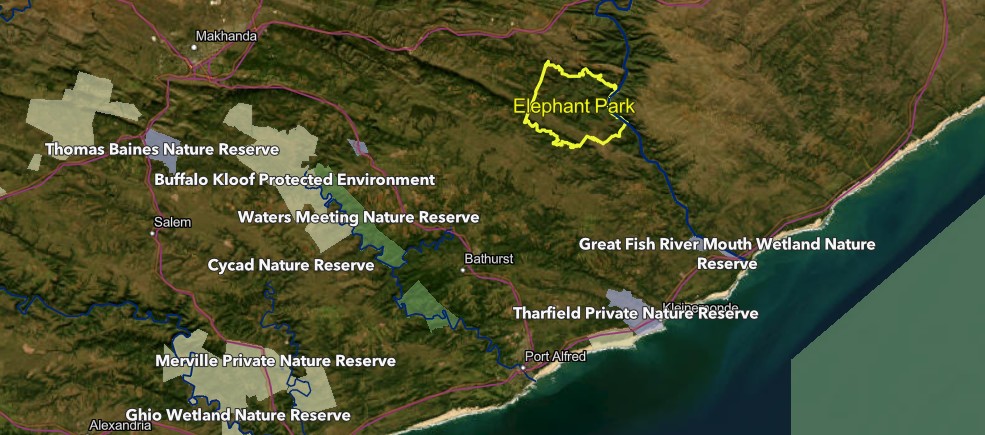
The property features a natural 4.5-kilometre boundary along the Great Fish River and is fully game-fenced. It includes essential infrastructure, such as a newly built 500m² main house and a 4-bedroom, 2-bathroom guest house with an entertainment area and garage. The main house and staff accommodation, consisting of a 3-bedroom unit, have been recently renovated. Additionally, there is a second 144m² house with a 28m² veranda, 3 bedrooms, one bathroom, an open-plan living area, an entertainment space, and a pool.
The property boasts extensive storage facilities, including a 900m² steel shed for vehicles and equipment, with offices, storage, and workshop space. Staff accommodations are provided in a large house equipped with power, water, and a kitchen.
Water supply is well-distributed across the farm, with 25 troughs, 14 earth dams, and 17 boreholes (10 solar-powered and 5 Eskom-powered). The water is stored in nine 30,000-litre zinc reservoirs and one 127,000-litre reservoir. The area receives an average annual rainfall of 550 mm.
Reserve Design
The reserve facilities are expected to occupy about 300 hectares. This fenced area will contain 2 to 4 holding bomas, transition areas, and other supporting buildings.
The elephant housing, boma, and transition areas will incorporate a mixture of elephant-proof fencing systems, both electrified and non-electrified, to ensure elephant and human safety, with the option to use both direct and protected contact management systems. Direct contact management occurs when the elephant and the handler share the same space without any barrier. In contrast, protected contact management occurs when a fixed barrier separates the elephant and the handler.
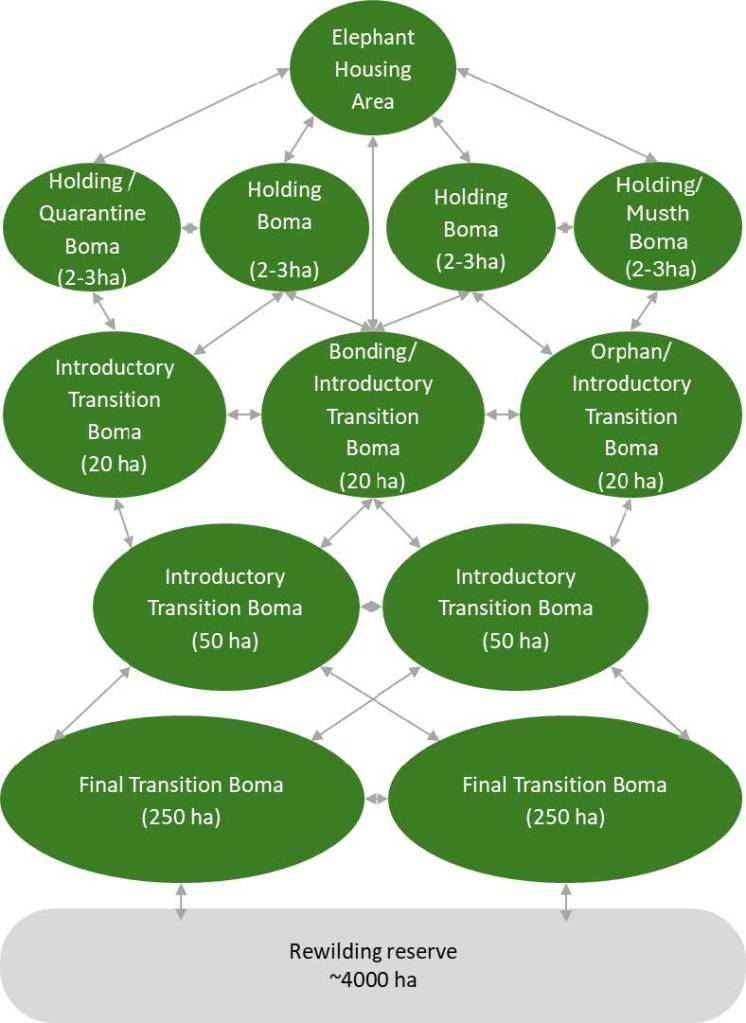
Fenced areas will include:
- Elephant Housing/Rehabilitation Area: A covered area with holding pens approximately 100m2 each. A Protected Contact Target Wall/ Fence system for veterinary care and husbandry management will be used. This area will include the orphan night stalls, food shed and working area. Time within is based on veterinary and husbandry requirements.
- Holding/Quarantine Boma: 2-3 hectares of bomas, where the elephants are held upon arrival to acclimatize and be monitored before access to the Introductory Transition Boma. Time within the holding boma will vary according to the elephant but would typically be between 2-10 days.
- Holding/Musth Boma: 2-3 hectares of bomas built to specifications to accommodate a musth bull, if needed.
- Orphan Boma: This 20-hectare boma is where orphans in the facility will spend the day and be monitored by caretakers. It is connected to the Elephant Housing Area, Holding, and Introductory Transition Bomas, where bonding with mothers can also occur. It can double as an Introductory Transition Boma.
- Bonding / Introductory Transition Boma: This is a 20-hectare boma where the elephants can bond with each other, recover from any physical ailments, transitionally adapt to their new environment, and be monitored for their readiness to move to the larger 50-hectare Introductory Boma for the next stage of reintegration. Time within the 20-hectare boma will typically range from a few days to one month. Physical injuries may impact the timeline.
- Introductory Transition Boma: A 50-hectare boma where the elephants transitionally adapt to their new environment and their progress and suitability for the next reintegration stage are assessed. Time within the Initial Transition Boma will typically be between 1 and 3 months.
- Final Transition Boma: A 250-hectare boma—the largest area of transitional natural habitat—where the elephants will live as their behaviours normalise and their disengagement from humans increases. Time within the Final Transition Boma typically lasts between 1 and 3 months.
- Rewilding Reserve: From 3,500 hectares and up and the location of the final stage of rewilding, where the elephants have no direct contact (outside of required veterinary intervention) but are monitored regularly—with unwanted behaviours corrected—to live out their lives as wild and free elephants.
Buildings, facilities, and equipment within the reserve will include:
- Research laboratory and administrative facilities for data and monitoring equipment
- Veterinary facility and bioanalysis lab (for blood samples, records, analysis, etc.)
- Secure food storage area
- Secure equipment storage area
- Staff accommodation
- Environmentally friendly waste disposal and recycling area
- Vehicle maintenance area
- Vehicles: 4×4 monitoring vehicles, staff transport, tractor, TLB excavator, pickup truck
 Rewilding Elephants