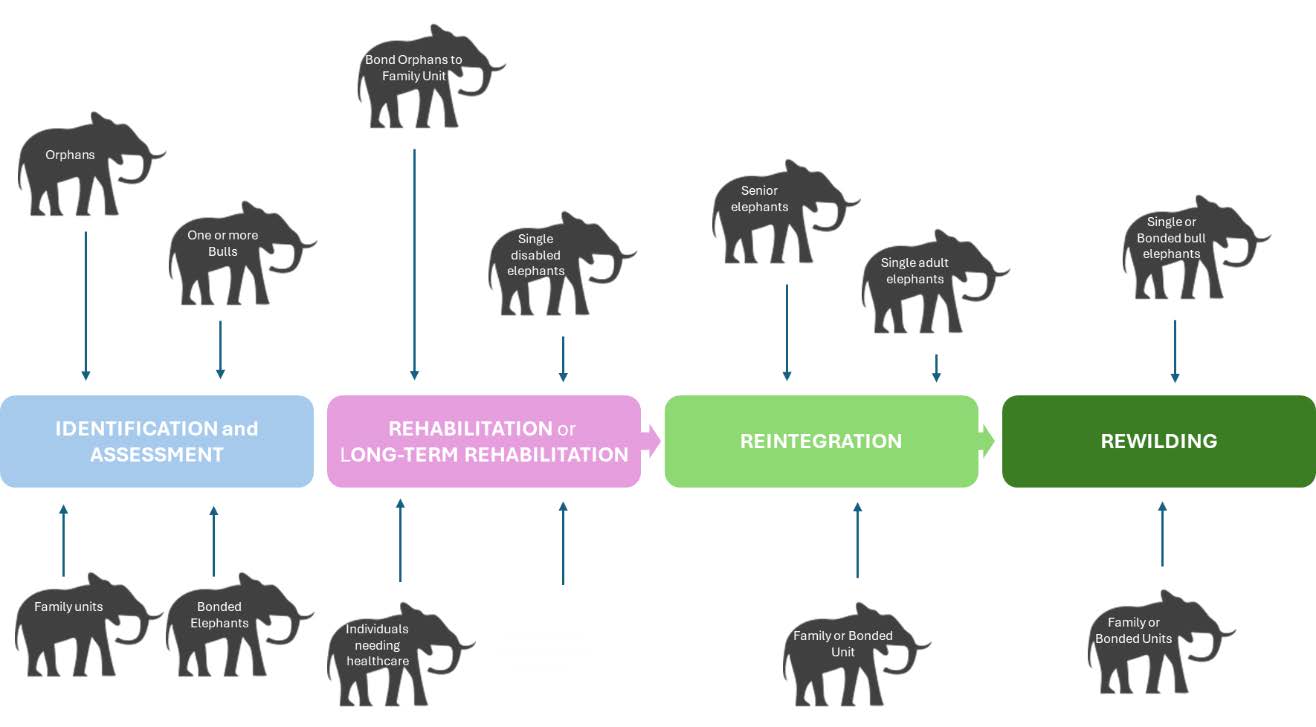
To ensure all elephants are afforded the chance to live a quality life with freedom of choice, the most ethical solution is to embark on a reintegration program and fully release them into a wild system. The process will be conducted in multiple stages, from identification and assessment to eventual rewilding. There is no set timeline for each stage, as each elephant/group is different and will require different steps and considerations at each stage. Graduation from each stage will be carefully assessed and measured, and each elephant will have a progression plan tailored to its individual needs.
Stage 1: Identification and Assessment
The first phase involves identifying the elephant/groups that will be transported to the reserve for reintegration and then assessing their characteristics to tailor a specific plan for each group and determine their baseline state and subsequent readiness for reintegration.
Identification
Elephant rewilding candidates will be sourced from captive facilities for commercial tourism, including zoos, elephant-back safaris, elephant interaction, and semi-captive elephants used for private reserve safaris. Negotiation will be conducted with facilities based upon willingness to surrender their captive elephants due to the management and economic challenges of keeping elephants. Some facilities may not be willing to surrender their elephants. Therefore, a different strategy may be required: (1) purchase to release elephants, with agreements not to purchase more elephants, and/or (2) advocacy that would pressure their economic model to encourage participation.
Assessment
Before leaving the captive facility, each elephant/group will undergo thorough assessment and monitoring to establish a tailored course of action for their arrival at the Rewilding Reserve, where possible (this may not be possible for all elephants and/or groups). Elephants will be monitored first at their location of origin to determine how best to conduct translocation and what additional requirements at the facility are required before their arrival, if any.
Assessments will involve behavioural observations using an ethogram developed to measure each elephant’s social bonds, baseline behavioural state, and stress levels from previous training to determine their overall suitability for rewilding and their current health standing via a medical assessment. A skilled monitoring team will be designated, based on the elephants’ requirements, to monitor and assess the elephant(s) at each stage, preferably the elephants’ handlers from the corresponding organization to assist with the transition in the initial stages and, where possible, be retained for future assistance.
The following criteria will be taken into consideration during the assessment phase:
- Behavioural pathology
- Elephant history and potential for reintegration
- Overall health and life history
- Social structures, herd, and bond groups (where possible, bonded groups at the facility will remain together for the course of the reintegration process to reduce trauma), and exhibitions of social behaviour
- Current and approaching reproductive stage (musth, allo-mothering potential, etc.)
Before transferring any elephants, the following reserve considerations will also be considered:
- Reserve/Boma Carrying Capacity
- Elephant Cow/Bull Ratio
- Elephant Age Ratio
- Elephant Genetic Pool
The elephant’s previous captive management history and the corresponding assessments will determine whether the reintegration process will be conducted under Direct Contact, Protected Contact, or No Contact handling to ensure the highest safety for the elephant and humans. Completing the assessment will include a structured plan for each elephant/group, adequate facilities to address the reintegration needs, corresponding staff, and any additional tools to support the reintegration process.
Stage 2: Rehabilitation
Rehabilitation is treating and caring for an injured, orphaned, or sick elephant who requires veterinary care to be physically fit for reintegration and eventual rewilding. Regardless of their ability to be rewilded, all elephants that enter the facility will undergo rehabilitation. Given time, all elephants have the potential to be rewilded unless there is a physical ailment hindering them. In cases where the reintegration process is long-term, or it is clear rewilding may not be an option due to age, illness, or life history due to the individual struggling with past trauma, they will undergo long-term rehabilitation, which entails a tailored sanctuary environment. This can be identified during the identification and assessment phase; however, if they cannot be rewilded, they can still undergo rehabilitation and be provided with the best possible care to ensure their well-being at the highest standard in a protected environment tailored to their specific needs.
Stage 3: Reintegration
Reintegration is the process of humans disengaging intensive management of previously captive elephants, reinstating autonomy with total freedom of choice whilst correcting unwanted behaviours to allow for transitioning back into a completely wild system (rewilding).
The assessment phase developed the most appropriate reintegration plan according to their individual needs. During the reintegration phase, the elephant(s) will move through the stages of transitional bomas while being continuously supported by humans with gradual disengagement.
The reintegration timeline will be determined by the elephant’s progress and will involve behavioural observations, faecal sampling for stress hormones, and tracking the movement and interactions among elephants while assessing their readiness for the next phase of reintegration via the following readiness indicators:
- Substantial exhibition of autonomy
- Reduced exhibition of aggressive behaviours
- Reduced exhibition of abnormal behaviours
- Activity budget (time spent in certain behaviours) comparable to that of wild elephants
- Appropriate exhibition of affiliative behaviours
Bond group development will be critical during the reintegration phase, whereas elephants will continually become reliant on one another instead of humans. Bonding individual elephants with one another will facilitate the rehabilitation, reintegration and rewilding phases as affiliative behaviour and social cohesion will create a more balanced individual; this may involve two individual bulls being bonded together or a single cow bonding with another natal group. Bonding is a gradual and important process during the reintegration phase, during which the elephants are introduced to each other through the Holding Boma and Bonding/ Introductory Bomas. Monitoring will occur by assessing various behaviours (aggression, affiliation, etc.) to determine their compatibility before allowing the elephants to inhabit the same boma.
Reintegration priority will be given to reuniting related elephants who may have been separated during earlier captures, as reinforcing family bonds can provide emotional benefits and facilitate reintegration. Captivity can create bonded groups that may not occur in the wild. However, these groups must be respected throughout the rehabilitation and reintegration stages. The individuals must be allowed to naturally determine the future of these bonded groups.
A soft reintegration/rewilding is when the individual(s) can acclimatize to their new lifestyle with familiar figures, allowing them to better adapt to the new system. A hard reintegration/rewilding happens when the individual is immediately disconnected from their current environment with no transitional period and is left to their own devices. This creates additional trauma that will likely reduce the success of reintegration/rewilding due to the nature of the release. No protocols will involve a hard reintegration. Instead, the soft reintegration/rewilding process will move in measured phases of bonded elephants, allowing them to adapt to the environment, recover from past trauma, and rebuild social integrity. A specialist support team will be established to oversee elephant welfare during the entire reintegration process.
Stage 4: Rewilding
Rewilding is the release of reintegrated elephants into a wild system without human interference, in which the elephant has full autonomy.
Rewilding is the final phase of the process, where elephants are fully released into an entirely natural system. Initially, elephants might still display signs of trauma, but such behaviours are expected to significantly decrease and stop as they adapt to their wild surroundings. Their adjustment to rewilding will be continuously monitored and assessed, focusing on behavioural health, stress hormone levels in their dung, and the formation of natural social bonds.
Rewilding also encompasses a broader approach than mere reintroduction, aiming to restore environments to their natural, uncultivated states by reintroducing species that were previously driven out. Elephants, as trophic rewilders, offer opportunities to create semi-open ecosystems and enhance biodiversity, which serves as an effective strategy to counteract recent ecological degradations (Bakker & Svenning, 2018; Gordon et al., 2023).
The complete stages, including protocols, for rewilding elephants into a wild system should outline all aspects of their reintegration process to ensure optimum safety for humans and elephants.
 Rewilding Elephants